
An industrial lift certificate is a statutory approval for a specific installation, not a sticker issued after a maintenance visit. You will be able to identify the responsible authority, assemble the right file, prepare for witnessed tests, and confirm whether a warehouse or factory lift is approved for the way you use it.
Key takeaways
- Certification applies to one lift at one named premises.
- Submit drawings, installation details, test reports and ownership documents.
- Inspectors test brakes, interlocks, alarms, limit switches and safety devices.
- Obtain the issued licence before using a warehouse or goods lift.
What industrial elevator certification actually approves
Certification approves a specific lift installation for operation at a named premises under Haryana’s lift-regulation system. Industrial elevator certification in Gurugram is therefore a statutory approval or licence process, not a BIS product-certification exercise and not an endorsement issued by the manufacturer or a private consultant.
A valid certificate should let you trace the approved equipment to:
- The factory or warehouse address and exact lift location
- Rated load, speed and permitted use
- Manufacturer or installer and serial or asset number
- Inspection findings, conditions and certificate or licence validity
- The approved arrangement for passengers, goods or both
That approval does not cover every lift in a site, and it does not authorise people to ride a goods lift when its controls, doors, guarding or signage approve goods handling only.
Maintenance keeps equipment working between inspections. An AMC visit records scheduled servicing and adjustments; it does not replace statutory inspection. A repair check confirms that a reported defect was addressed, while a general survey identifies condition, capacity or upgrade issues without granting legal permission to operate.
A recent certificate also does not excuse neglected maintenance or an unresolved dangerous defect.
Use elevator consultancy in Gurugram before installation or major alteration when shaft dimensions, loading, dock access, electrical supply or maintenance access could affect compliance. The consultant supports readiness; the state-designated lift or electrical-inspection authority grants approval.
Who issues approval and what the application file must contain
Approval comes from Haryana’s Electrical Inspectorate: the Electrical Inspector or another lift authority designated under Haryana’s lift rules. The owner or occupier must apply before commissioning a new, relocated or materially altered lift. The authority checks the application, schedules a site visit, examines the installation and witnesses or reviews prescribed tests.
Defects lead to written rectification requirements; approval follows only after satisfactory compliance.
| Authority or provider | What it does | What it cannot replace |
|---|---|---|
| Electrical Inspectorate, Haryana | Inspects and issues the applicable lift approval, licence or certificate | Cannot approve an unidentified or materially changed lift without fresh review |
| Factory inspector | Examines workplace guarding, loading, operators and maintenance practices | A factory elevator inspection does not replace statutory lift approval |
| Manufacturer or consultant | Supplies drawings, declarations, test results or application support | Cannot issue Haryana’s statutory operating approval |
Submit a separate file for each lift, with:
- The prescribed application form, fee receipt and owner or occupier details
- Premises address, lift location, rated load, speed, manufacturer or installer, serial or asset number and intended use
- Approved layout and shaft drawings, machine-room or drive details, electrical schematic and safety-device details
- Installation completion declaration, manufacturer’s test certificate and commissioning results
- Earthing and electrical-safety test report, structural or support certificates, and rectification evidence for earlier defects
- Maintenance-provider details and previous approval or inspection records for an existing lift
Industrial elevator certification in Gurugram is therefore tied to one traceable installation, not every lift at a factory or warehouse. The issued document should show its certificate number, premises, lift identity, conditions and next inspection date.
What inspectors examine and test at a factory
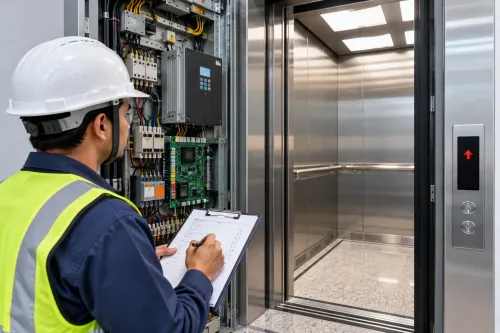
Inspectors combine a document audit with witnessed tests. During a factory elevator inspection, they identify the installation by premises, rated load, speed, manufacturer, serial or asset number, and then compare its condition with approved drawings and specifications.
| Area | What inspectors examine or test | What a failure indicates |
|---|---|---|
| Mechanical | Motor, machine or drive, brake, traction sheave, ropes or belts, counterweight, guide rails, car movement, buffers and no-load and rated-load trials | The lift may slip, stop inaccurately, overload the drive or fail to arrest safely |
| Electrical | Control panel, protective devices, wiring, insulation resistance, earth continuity, earth resistance, emergency supply, overload device and control operation | Shock, fire, nuisance trips or uncontrolled movement remains possible |
| Structural | Shaft and pit dimensions, machine-room or machine-space arrangement, rail brackets, landing entrances, guarding, pit clearance and anchorage | The installation may not match sanctioned drawings or provide safe clearances |
| Safety | Car and landing doors, door locks and interlocks, governor, safety gear, overspeed operation, buffers, alarm, emergency communication and limit switches | A door could open during travel, or the car might not stop during overspeed |
The file should include manufacturer test certificates, safety-component certificates where applicable, wiring and earthing results, brake and overspeed tests, door-interlock tests, trial results and the maintenance logbook. Inspectors also check safety signage and whether the equipment is presented for its approved use.
A factory inspector’s occupational-safety visit does not replace statutory lift approval. Industrial elevator certification in Gurugram attaches to that identified lift at that premises, not to every lift in the factory.
How warehouse and goods lifts are assessed for their actual use
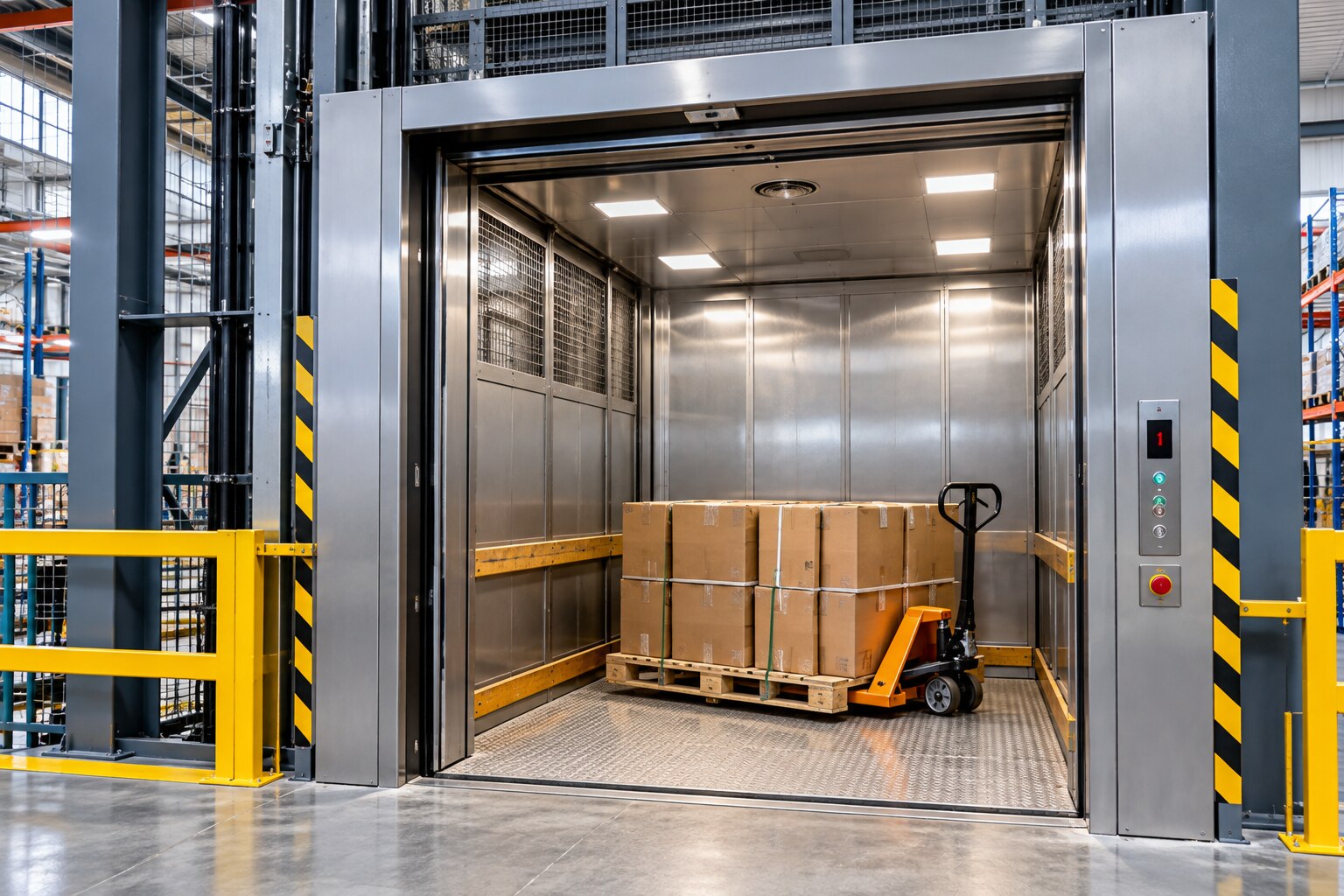
Approval follows the lift’s actual job, not its label. For warehouse lift certification in Gurugram, the inspector matches the rated load, car dimensions, door openings, platform strength and control arrangement to the proposed handling method. A pallet load needs enough floor area, clearance and restraint to prevent shifting during travel.
A forklift changes the assessment. Check the lift’s permissible wheel or axle loading, entry clearance, turning space, ramp or sill condition, and whether the operator is allowed to remain inside during movement. The certificate must state the permitted load and use; never treat a standard pallet rating as automatic approval for a loaded forklift.
The inspection also checks whether the installation is configured for people. A goods lift is not automatically a passenger lift, and carrying workers contrary to its approval creates a safety and compliance breach.
Goods lift certification must align the car and landing doors, guarding, controls, emergency communication and warning signs with goods-only or approved passenger use.
Confirm that the certificate identifies one installation at one premises, including its location, rated load, speed, manufacturer or installer, and serial or asset number. Ask the inspector or authority to record:
- pallet size, total load and loading method
- forklift dimensions, axle loads and operator rules
- passenger permission or prohibition
- load signage, interlocks, guarding and emergency controls
Changing capacity, doors, controller, travel, shaft layout or intended use requires technical review and reinspection before operation.
What the certificate permits and when you need technical help
A certificate permits operation only for the lift, premises, rated load, speed and use named on it. Verify the issuing Haryana authority, certificate number, issue date, validity or next inspection date, conditions, and asset details against the lift’s plate and records; a consultant’s report is not statutory approval.
1. Record each lift separately by location, serial or asset number, manufacturer, rated load and speed. A certificate for one warehouse lift does not cover every installation on the site.
2. Stop operation and arrange defect rectification when a safety device fails, a door interlock is unreliable, ropes or belts are damaged, abnormal braking occurs, or the lift exceeds its approved use. Maintenance records and repair completion evidence do not replace required authority testing.
3. Obtain technical review before changing the rated load or speed, controller, traction machine, car, doors, travel, shaft arrangement or lift purpose. Conversion from goods use to passenger use can require revised drawings, testing and reinspection; goods lift certification does not authorise passengers.
4. Choose elevator consultancy in Gurugram before inspection when drawings are missing, records conflict, a material alteration is planned, or the certificate’s scope is unclear. Ask X Pro Elevators, or any consultant, to state whether its deliverable is design review, statutory application, test witnessing or an authority-issued licence.
A warehouse lift certification in Gurugram is worth challenging if the document omits the lift identity, permitted use or operating conditions. Do not operate while waiting for clarification of a serious defect.
Frequently asked questions
What does industrial elevator certification in Gurugram approve?
It approves a specific lift installation for operation at a named factory, warehouse or other premises under Haryana’s lift-regulation system. It does not certify the manufacturer’s product under BIS rules.
Who issues industrial elevator approval in Gurugram?
The approval comes from Haryana’s designated lift and electrical safety authority, not from the elevator manufacturer or a private consultant. Check the issued licence for the premises, lift identification and permitted use.
What does a factory elevator inspection examine?
Inspectors examine the shaft, machine room, car, landing doors, interlocks, brakes, limit switches, emergency alarm, overspeed protection, safety gear, earthing and related records. They also witness operating and safety tests.
How is warehouse lift certification in Gurugram different for goods lifts?
Inspectors compare the lift’s rated load, platform or car design, guarding, loading method, travel, access points and safety devices with its actual warehouse use. A goods lift must not carry people unless its approved design and licence permit passenger use.