
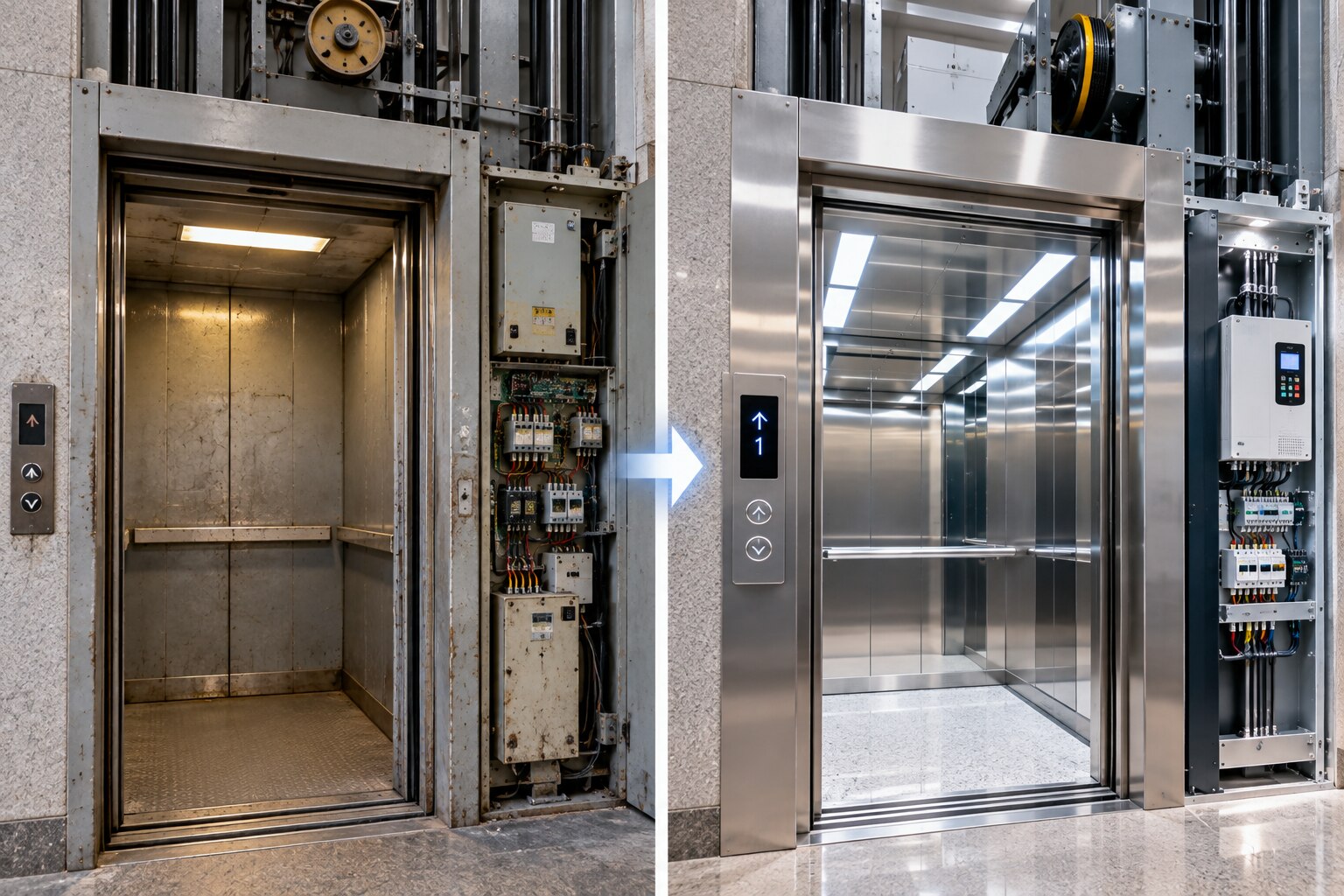
An older hotel lift can remain unreliable even after regular repairs when its controller, door operator, safety circuit, brake system or spare-parts supply has reached the end of its practical service life. By comparing the lift’s condition, hotel traffic and shutdown constraints, you can choose a targeted upgrade, full modernization or complete replacement without paying for work the building does not need.
Key takeaways
- Repeated faults and obsolete parts can justify modernization before full replacement.
- Choose partial upgrades, full modernization, or replacement based on system condition.
- Schedule noisy work around hotel occupancy, events, and guest movement.
- Verify safety devices, records, testing, and approvals before reopening the lift.
When repeated repairs signal that a hotel lift needs modernization
A single door reversal or shutdown does not prove that a hotel lift needs replacement. Modernization becomes the stronger case when the same faults return after repair, parts for obsolete relay logic or controllers take weeks to source, and inspection records show deterioration across several systems.
Use this procedure:
1. Compare the breakdown history with fault codes, inspection records and safety-device tests. Repeated door reversals, landing-door interlock faults, jerky starts or stops, floor mislevelling and recurring shutdowns indicate a system problem when repairs provide only temporary relief.
2. Survey the equipment condition. Check the traction machine, motor, brake, ropes, sheaves, guide components and obsolete safety circuits, along with pit, shaft and overhead clearances. A serviceable motor or machine can remain; a generic quotation cannot establish that decision.
3. Match failures to duty cycle. Guest lifts absorb luggage impacts and concentrated check-in traffic; kitchen and service lifts take trolley contact, linen, food and waste loads; cleaning chemicals collect in sill channels; fire lifts require dependable emergency operation. An old lift upgrade Gurgaon project must reflect these different stresses.
4. Specify the evidence before approving work: lift age, rated load and speed, parts availability, rescue history, recurring faults and component test results. Choose modernization only when that condition survey shows lifecycle risk exceeding the cost and disruption of another isolated repair.
What a hotel lift modernization project can actually replace
Modernization is a menu of scopes, not a single product. An elevator upgrade for hotels in Gurugram might replace only obsolete controls and doors, or extend to the machine and safety systems.
| Option | Typical replacements | When it applies |
|---|---|---|
| Partial controls | Controller, VVVF drive, encoder feedback, motor tuning, position sensors, car operating panel, push buttons and floor indicators | The hoist machine and structure pass inspection |
| Door and cabin scope | Door operators, landing-door locks, door-edge or light-curtain protection, robust sills, LED lighting and ventilation controls | Door faults, poor cabin usability or worn sill channels drive complaints |
| Rescue scope | Emergency battery lowering or automatic rescue device | Entrapments follow power interruptions, after compatibility checks |
| Full modernization | The above systems plus machine, brake, ropes, sheave or safety interfaces | Several systems are obsolete or unreliable |
Retain the hoist machine only after checking brake release and application, bearings, sheave grooves, ropes, structural anchorage, guide rails, car frame, buffers, pit clearance and overhead clearance. A serviceable motor does not justify retaining a discontinued controller.
Changing rated speed or load is an engineering redesign. Check the motor, brake, ropes, sheave, counterweight, governor, safety gear, guide rails, buffers and electrical protection before approval.
Emergency rescue equipment lowers entrapment risk after power loss; it does not replace generator supply, fire recall, fireman’s operation or two-way communication. Ask for compatibility tests with the brake, controller and door locks.
Partial upgrade, full modernization or complete replacement: which fits the hotel?
Choose the scope from an asset-by-asset condition survey, not a generic replacement quotation. Record the lift’s age, load, speed, machine and brake type, controller obsolescence, door condition, rope and sheave wear, clearances, fault history, rescue history and parts availability.
| Option | Capital cost and outage | Civil work, parts and lifecycle risk |
|---|---|---|
| Partial upgrade | Lowest cost and shortest outage | Suits a serviceable machine, brake, ropes, sheave and structure when the controller, drive, door operator, indicators or rescue system are the main risks |
| Full modernization | Medium-to-high cost with a longer planned outage | Suits several obsolete systems where the shaft, car frame and machine pass inspection; combines controller, VVVF drive, doors, safety interfaces, cabin controls, rescue equipment and energy-saving features |
| Complete replacement | Highest cost and longest outage | Suits structural deterioration, inadequate pit or overhead, unavailable major parts, poor accessibility, unsuitable capacity, or speed and traffic demands the existing equipment cannot meet |
A full modernization is not automatically the best hotel elevator modernization in Gurugram. Compare capital cost, shutdown duration, civil work, future parts availability, energy use and lifecycle risk across guest, kitchen, service and fire lifts, whose duty cycles differ sharply.
A VVVF drive alone does not guarantee smooth travel. Levelling depends on brake timing, encoder feedback, load measurement, motor tuning, rope stretch, sheave condition and door-zone sensing; test empty, rated-load and representative hotel-service trips before acceptance.
Increasing speed or load also requires engineering checks for ropes, brake, motor, governor, buffers, guide rails, car frame, pit and overhead.
How to modernize without disrupting hotel guests and events
Start with an asset-by-asset survey, not a generic quotation. Record each lift’s duty, rated load, speed, controller, brake, door operator, rope and sheave wear, fault history, parts lead time, pit and overhead condition, and fire-lift role. An elevator upgrade for hotels in Gurugram must protect operations as well as equipment.
1. Modernize one lift at a time. Keep separate arrangements for guest, luggage, kitchen, service and fire-lift duties, with a written emergency alternative if one car is removed. Provide temporary accessible and luggage routes, signs, staff assistance and protected paths.
2. Set the shutdown calendar around occupancy. Avoid check-in, check-out, conferences, weddings and banquet surges; schedule cutting, drilling and other noisy work at night. State the maximum outage, escalation contact and response time for an unexpected shutdown.
3. Control the worksite daily. Install temporary guarding at landings, protect guests from dust and tools, seal work zones, clean sill channels and corridors, and restrict access to machine rooms, pits and landing areas. Housekeeping must know which routes and floors are closed.
4. Put commercial responsibilities in the specification. Name spare-parts lead times, reopening responsibilities, testing requirements and the party paying for concealed pit or shaft defects.
Program group control for hotel traffic: give service lifts priority when moving linen, food or waste; define accessible-car behaviour, car allocation and recovery after a failure. Check-in peaks need a different dispatch strategy from office traffic.
Allow for Gurugram’s monsoon moisture, dust, heat, basement or machine-room exposure, voltage variation and generator changeover. Coordinate fire recall, fireman’s operation and power transfer with the building systems before reopening.
How to approve the work and verify the modernized lift
Reject any bid that begins with a generic replacement quotation. For hotel elevator modernization in Gurugram, appoint a hotel lift modernization company only after an asset-by-asset survey and a written acceptance plan.
1. Record each lift’s age, rated load, speed, machine and brake type, controller status, door condition, rope and sheave wear, pit and overhead clearances, fault history, rescue history, parts availability, energy baseline and inspection records. X Pro Elevators can be one bidder evaluated against comparable companies on this documented scope.
2. Witness empty-car and full-load travel, with measured stopping comfort and levelling at every floor. Test door reversal, obstruction detection, emergency stop, brake performance, alarm, two-way communication and automatic rescue. Where modernization disturbed them, test the overspeed governor and safety gear.
3. Simulate generator transfer, phase failure, fire recall, fireman’s operation and group-control failure. Test the lift’s recovery after one car is removed from service, not just normal operation with every car available.
4. Define energy measurement as kWh per trip or kWh per operating day, and state the measurement boundary. ISO 25745 offers an assessment framework, but an energy class does not prove better availability.
5. Withhold final payment until the closeout file contains updated drawings, as-built wiring diagrams, test certificates, safety-device records, rescue instructions, logbook entries and operator-training records. Confirm the current Haryana inspection, approval, licence or re-licensing process with the state lift authority or Chief Electrical Inspector. A vendor commissioning sheet is not regulatory handover.
Related service
Modernization Modernization Our Elevators AMC price are very competitive in NCR region & dedicated team |
Frequently asked questions
When do repeated repairs indicate that a hotel lift needs modernization?
Modernization becomes a stronger option when the same faults return, obsolete relay logic or controller parts take weeks to source, or inspection records show deterioration across several systems.
What parts can a hotel lift modernization project replace?
A project can replace selected systems such as the controller, drive, door operator, wiring, landing fixtures, car operating panel, machine, or safety components, depending on their condition and compatibility.
Should a hotel choose a partial upgrade, full modernization, or complete replacement?
Choose a partial upgrade when one system is causing trouble and the rest remains sound. Choose full modernization when several connected systems are outdated. Choose replacement when the existing equipment cannot support safe, reliable integration or the building needs a different lift capacity or layout.
How can a hotel modernize a lift without disrupting guests and events?
Plan shutdowns during low-occupancy periods, coordinate noisy work with event schedules, provide clear guest routes, and sequence the project so staff and emergency access remain practical.
How should a hotel verify a modernized lift before reopening?
Review test results, confirm safety devices and door operation, inspect ride performance and emergency communication, collect updated maintenance and inspection records, and obtain the required approval before returning the lift to service.