

A warehouse goods elevator must be designed around pallets, wheel loads, traffic peaks and building interfaces—not selected from rated capacity alone. By the end, you will know how to define the lift, prepare the site, compare quotations and confirm that the completed installation is safe, compliant and usable.
Key takeaways
- Match rated load to pallet weight, cage dimensions and peak traffic.
- Reserve shaft, pit, headroom, power supply and landing access before ordering.
- Assign civil, electrical, fire and safety responsibilities in writing.
- Require load testing, interlock checks, manuals and handover records.
What type of lift does your warehouse actually need?
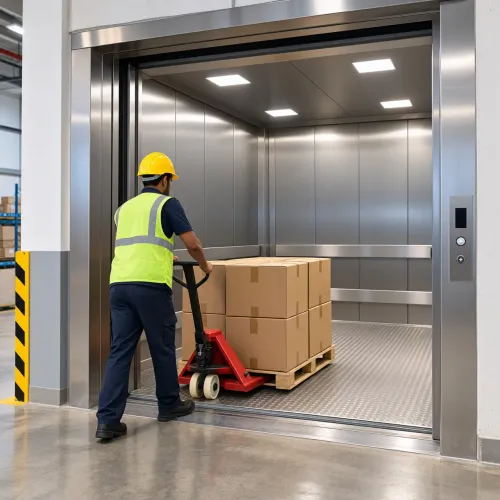
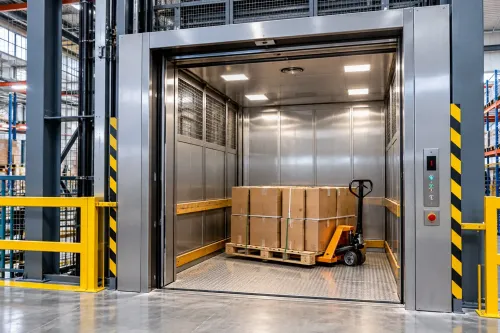
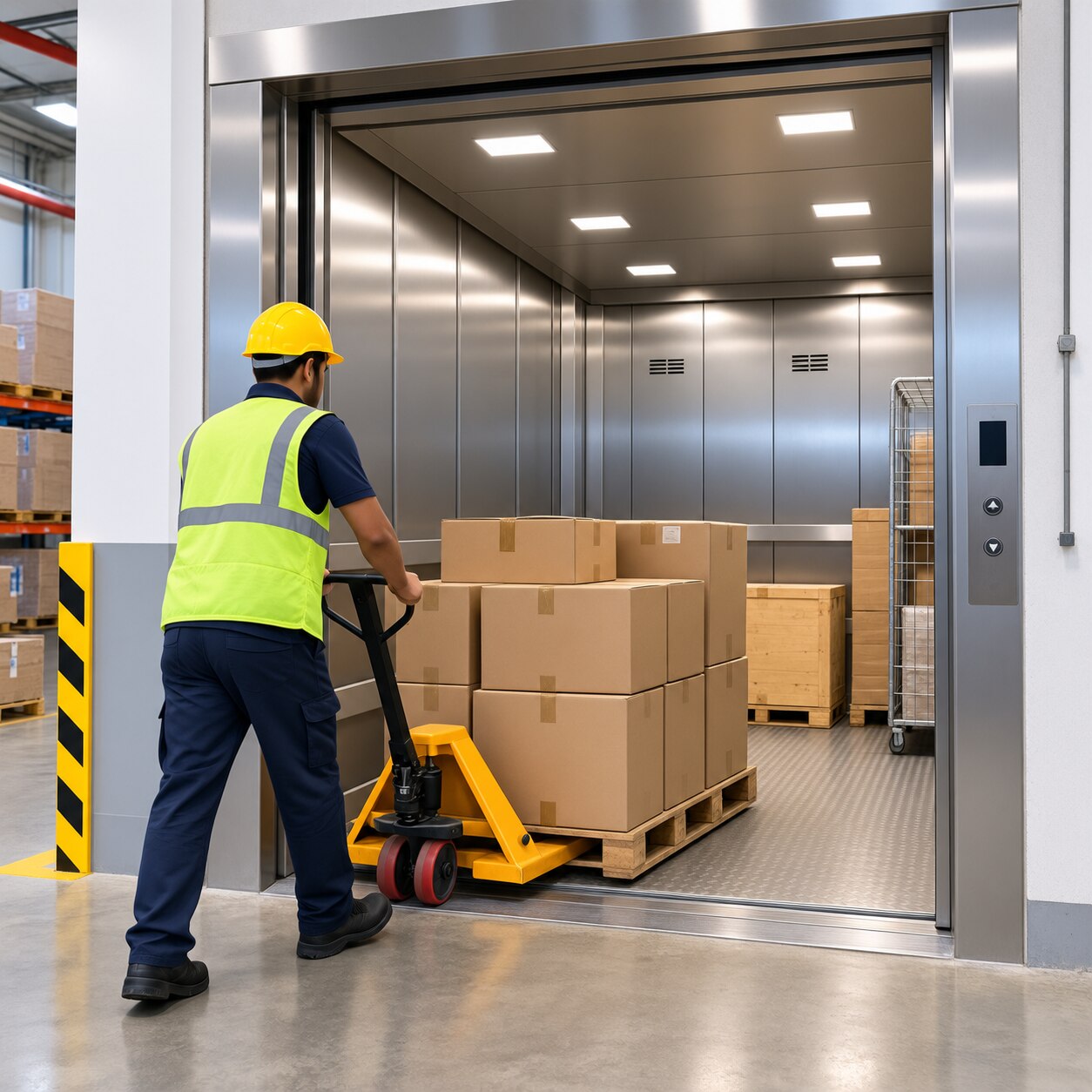
Choose a permanent goods elevator when pallets or cages must travel between fixed landings in a guided car with landing doors, safety interlocks, controlled stopping and a permanent shaft. It is not a passenger lift, dumbwaiter, pallet lift, forklift or vertical reciprocating conveyor; each serves different loads, access conditions and duty cycles.
A site hoist or open goods platform cannot be reclassified as a permanent warehouse elevator after installation.
For goods elevator installation for warehouse in gurugram, put these decisions in the design brief:
- Pallet or cage dimensions, maximum unit load and loading equipment
- Travel height, number of landings, daily trips and loading direction
- Pallet-truck or forklift entry method and whether an attendant is permitted
- Goods-only status, with locked or controlled access, signage, operating rules and authorised operators
If repeated short moves suit a forklift, conveyor, stacker crane or redesigned loading dock, that option may deliver higher throughput and better resilience. Select the lift only after checking whether the building’s fire strategy, fire NOC and compartmentation drawings permit it; a freight lift is not a fire escape.
The lift category must match the work, building and legal use.
How should you calculate capacity, dimensions and warehouse traffic?
Rated load alone is inadequate: calculate the combined weight of the pallet, goods, cage, pallet truck or forklift attachment, and permitted operator. Then check concentrated wheel loads, eccentric loading and expected future throughput.
Specify the following before requesting quotations:
- Cabin depth and width, pallet dimensions, clear door opening and floor-to-floor travel.
- Sill design, floor finish, approach speed, wheel-impact protection and exact pallet positioning.
- Loading direction, landing count, lifts per hour and whether an attendant is permitted.
| Car arrangement | Flow benefit | When it applies |
|---|---|---|
| Single-entry car | One loading face; reversing may be necessary | Separate receiving and dispatch routes do not conflict |
| Through-car | Opposite doors separate receiving from dispatch and reduce reversing | Traffic crosses the building or handling conflicts are likely |
Calculate capacity from peak-shift arrivals, loading time, unloading time, travel time and door cycles. Compare the resulting lifts per hour and queue length with the lift’s duty cycle, not its nominal capacity.
Undersized doors, incompatible pallets, poor floor alignment, missing staging areas and forklift impacts at sills or car edges cause failures. For warehouse freight lift installation in Gurugram, use measured flow and wheel loads as procurement inputs, not a guessed cabin rating.
Which lift configuration and site conditions fit the building?
Choose the configuration against travel, traffic and the building envelope—not catalogue capacity. For industrial goods lift installation, the trade-offs are:
| Option | Speed, travel and duty | Building, energy and access |
|---|---|---|
| Hydraulic | Low-to-moderate speed; short or medium travel; intermittent duty | Deeper pit, overhead clearance and machine room; higher running energy; accessible equipment |
| Traction | Higher speed; tall buildings and intensive duty cycles | Shallower pit possible, but requires headroom, machine beams and stronger reactions; better energy efficiency; service access is essential |
| Machine-room-less traction | Medium-to-high speed and duty | No separate machine room, but overhead equipment needs clearance and safe maintenance access; efficient, with difficult rescue access if poorly planned |
Before fabrication, obtain a signed survey covering:
- Shaft or steel-tower dimensions, plumbness, pit construction, drainage, overhead clearance and landing openings
- Slab capacity, guide-rail bracket anchorage, machine-beam or traction-equipment reactions and sill supports
- Ventilation, lighting, feeder, isolator, earthing and emergency power
- Crane or handling-equipment access, existing-building modifications, future maintenance routes and forklift impact protection at sills, doors and car-floor edges
In Gurugram, protect outdoor shafts from monsoon ingress and design for dust, heat, humidity, corrosive goods and wash-down. Review anchorage under applicable Indian seismic provisions, including IS 1893 Zone IV considerations; never accept standard brackets without checking the building.
What civil, electrical and safety work must be assigned before installation?
Before fabrication, sign a responsibility matrix with named parties, dates and interface drawings. Confirm shaft openings, pit construction and drainage, structural supports, fire stopping, landing doors, slab reinstatement, power feeder, isolator, earthing, ventilation, lighting, emergency power and access platforms.
| Item | Assign and verify |
|---|---|
| Shaft and fire separation | Builder provides plumb openings, rated shaft, fire stopping and landing-door treatment matching the National Building Code, fire strategy, fire NOC and approved compartmentation drawings. A freight lift is not a fire escape. |
| Structure and access | Structural engineer approves guide-rail brackets, machine supports, pit loads, platforms and pallet-impact guards; builder reinstates slabs and protects sills. |
| Electrical and recovery | Electrical contractor provides feeder, lockable isolator, earthing, lighting, ventilation and specified emergency supply. Automatic rescue operation is not generator supply. |
| Authority and records | Tender names exact editions and applicable parts of IS 14665, IS 17491 and related standards. Confirm the current Haryana lift-authority process, drawing submitter, inspection applicant and required test records. |
Verify landing and car-door interlocks, overspeed protection, brakes, buffers, final limits, overload protection, emergency alarm, two-way communication, car-top controls, door protection, pit access, emergency lighting, emergency lowering and pallet-impact protection. Record load, stopping, interlock, brake, overspeed, buffer, electrical and earthing tests before statutory inspection and handover.
What happens during installation, testing and handover?
1. Installation starts with a site survey and signed interface drawings covering plumbness, pit, openings, sills, anchors, power and drainage.
2. Complete civil and electrical preparation before delivery: supports, pit, fire stopping, reinstatement, feeder, isolator, earthing, lighting and ventilation. Expect civil work, warehouse shutdowns and power isolation.
3. Confirm crane or handling access, delivery route and laydown area. Temporary barriers and blocked loading routes can stop receiving and dispatch.
4. Install guide rails, then the machine, controller and car; fit landing doors and wire safety circuits, alarm and communication. Crane access and lifting exclusion zones disrupt operations.
5. Commission and record functional and load tests, stopping accuracy, interlocks, brakes, overload, final limits, overspeed protection, buffers, electrical protection and earthing.
6. Request separate quotation lines for civil modifications, electrical upgrades, permits, statutory inspection, testing, emergency power, crane or handling access and operator training. Automatic rescue operation is not generator supply.
7. Obtain the Haryana authority inspection or permission required under current regulations before use. Handover must include approved drawings, test certificates, load and stopping records, interlock and brake results, earthing records, instructions, rescue procedures, emergency contacts, maintenance logs and a responsibility matrix.
8. Train authorised operators. The rescue plan must bar untrained staff from opening landing doors or bypassing interlocks, overload devices, governor circuits or final limits. Include civil reinstatement sign-off.
How do you compare suppliers and keep the lift reliable after handover?
Score every bidder against evidence, not claims. Ask each warehouse elevator company in Gurugram for signed load and traffic calculations, dimensioned general-arrangement drawings, local service coverage, spare-parts access, response arrangements, warranty exclusions, AMC scope and named handover documents.
| Bid criterion | Evidence to demand | Why it matters |
|---|---|---|
| Load and traffic | Signed calculations using pallet, equipment and operator weights | Prevents an undersized lift and queueing |
| Design interfaces | Dimensioned drawings showing shaft, pit, openings, sills and supports | Exposes civil and structural gaps |
| Service support | Local attendance times, parts sources and escalation contacts | Limits operational downtime |
| Handover | Test certificates, approved drawings, rescue procedure, manuals, logs and training record | Creates an auditable operating baseline |
Make the maintenance contract separate statutory inspection, preventive maintenance and breakdown response. Specify attendance times, entrapment escalation, after-hours coverage, parts responsibility, lubrication limits, controller fault-log review, functional or proof-load tests, cleaning limits and who may reset safety circuits.
No technician may bypass a door interlock, governor circuit, overload device or final limit to keep dispatch moving.
After handover, use authorised operators, marked loading limits, correct pallet positioning, door discipline, daily checks, debris removal and incident isolation. Set intervals by trips, dust, pallet debris, temperature and wash-down exposure. X Pro Elevators can be evaluated on these deliverables rather than general reliability claims.
Coordinate with landlords, facility managers and multi-tenant operators. Reject any bid that selects cabin capacity without proving throughput, structural interfaces and lifecycle support.
Related services
New Installation At X Pro Elevators, we specialize in delivering high-quality, reliable, and innovative elevator solutions tailored to your needs. View service → |
Elevator Certification and Consultancy Elevator Certification and Consultancy A lift survey can tell you just about anything you need to know about your lift. View service → |
Frequently asked questions
What type of lift does a warehouse need?
Choose a permanent goods elevator when pallets or cages travel between fixed landings in a guided car with landing doors, safety interlocks and a permanent shaft. Compare it with pallet lifts, forklifts and vertical reciprocating conveyors before selecting equipment.
How do you calculate warehouse elevator capacity?
Add the heaviest pallet or cage load, handling equipment weight and a margin required by the selected design. Check car width, depth, height, door opening and traffic frequency against the largest load and peak movement schedule.
What site conditions must be checked before installation?
Survey the shaft location, pit depth, headroom, landing alignment, wall strength, machine-room arrangement, drainage, ventilation, access route and electrical supply before finalising the lift.
What work must be assigned before installation?
Assign shaft and pit construction, structural openings, landing finishes, power cabling, earthing, lighting, drainage, fire interfaces, access control and safety responsibilities to named parties.
What happens during testing and handover?
The installer aligns and tests the lift, checks door locks and interlocks, verifies controls and safety devices, performs the required load tests, then hands over drawings, manuals, certificates, inspection records and maintenance instructions.