
A warehouse lift that meets its old nameplate capacity can still fail the operation because of forklift impact, poor door geometry, excessive starts or unsuitable controls. By comparing component upgrades, partial and full modernization, and a new goods lift against measured site requirements, you can choose a safer project with fewer surprises in cost and downtime.
Key takeaways
- Measure loaded movements, axle loads and impact—not only rated capacity.
- Compare controller, drive, door and full-lift replacement paths.
- Reuse components only after inspection, records review and compatibility checks.
- Require safety integration, acceptance tests, downtime plans and lifecycle documents.
Start with the warehouse duty cycle, not the old nameplate
Count loaded movements, not just the existing rated load. A lift that carries 2,000 kg on its nameplate can still fail the warehouse if a forklift creates concentrated axle or impact loads, or if the pallet’s centre of gravity sits outside the car’s design assumptions.
Survey the duty cycle and loading interface before selecting equipment:
- Pallet, trolley and forklift length, width, height, total mass and centre of gravity
- Forklift axle loads, wheel spacing and approach direction
- Starts per hour, loaded and unloaded trips, operating hours and expected future throughput
- Travel distance, number of stops and the busiest landing
- Loading method, door clear width and height, threshold tolerance and forklift approach geometry
- Sill strength, impact protection, door-cycle time, obstruction sensing and replacement-door-operator availability
- Pit depth, headroom, shaft dimensions and environmental exposure
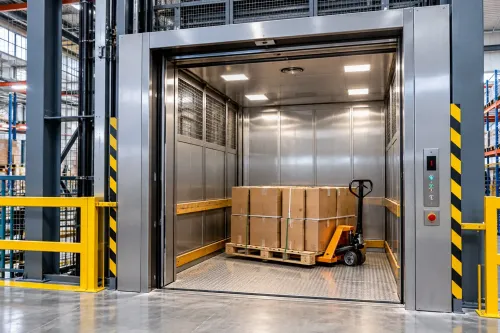
Use the heaviest real load and the harshest loading event to establish rated capacity, car size, hoisting duty and door construction. Door performance can determine productivity more than lifting speed; repeated forklift strikes damage doors, interlocks and sill supports while the hoisting machine remains serviceable.
Confirm whether people are permitted to travel in the car. A goods-only lift is not a passenger lift because workers occasionally ride with cargo; changing that use can require different controls, doors, safety equipment, signage and statutory approval.
This duty-cycle survey is the design basis for freight elevator modernization in Gurugram and goods lift modernization in Gurugram.
Compare the upgrade paths from one component to a new lift
A condition-based partial modernization usually gives the best balance when the shaft, car frame, rails and machine still pass dimensional and functional checks. It improves the weak link without paying for equipment that has useful life left.
| Option | Performance and reliability | Disruption and remaining life |
|---|---|---|
| Controller and VFD | Better levelling, dispatching, soft starting and diagnostics; old brakes, ropes, sheave and motor remain risks | Short outage; worthwhile only when retained equipment has verified life |
| Door operator, sill or car-enclosure upgrade | Faster, safer loading and better impact resistance; it addresses the warehouse interface directly | Moderate outage; strong choice when forklift damage limits throughput |
| Traction-machine replacement | Restores torque, braking and reliability while retaining compatible rails, sling and shaft | Longer outage; suits a sound structure with a worn machine |
| Hydraulic refurbishment | Replaces leaking valves, seals, pump or hoses; useful for low-rise lifts | Moderate disruption; poor fit if speed, heat or high cycle rates demand more |
| Full replacement | New controller, drive, machine, doors, car and safety systems provide the longest design life | Greatest cost and outage; select it when multiple major systems are obsolete |
| New lift installation | Removes inherited constraints and suits a changed shaft or duty cycle | Highest disruption; justified when the existing layout cannot meet load, clear opening or throughput |
For an industrial elevator upgrade in Gurugram, require the quotation to name every retained component, its inspection method, remaining design life and compatibility responsibility. For warehouse lift modernization in Gurugram, choose full replacement when several systems fail together; do not let a new controller disguise old mechanical risk.
Decide which existing lift components are safe to reuse
Reuse is safe only when measured condition, compatibility and remaining design life support it. Commission a documented survey before ordering controls: verify shaft dimensions, pit corrosion, overhead clearance, rail alignment, machinery condition and landing-door geometry. A visual pass is not enough; a new controller can expose worn mechanics through vibration, levelling errors or unreliable stopping.
Require the survey to record:
- Rail straightness, bracket alignment and anchor security, measured against the lift manufacturer’s tolerances.
- Car-frame welds, sling, guide shoes or rollers, safety gear and counterweight condition.
- Traction-machine bearings, rope grooves, ropes, brake torque and sheave wear; for hydraulic lifts, cylinder, seals, valve performance and oil leakage.
- Pit buffers, isolation switches, water damage and corrosion, plus shaft clearances and headroom.
- Landing doors, interlocks, sills, sill supports, door operators and impact damage from forklifts.
| Component | Retain only if | Replace or refurbish when |
|---|---|---|
| Shaft and rails | Survey confirms alignment, anchors, clearances and structural integrity | Corrosion, movement or dimensional failure remains |
| Machine and brake | Test results meet stopping, bearing and brake-performance limits | Parts are obsolete, cracked, worn or incompatible with the controller |
| Doors and landings | Interlocks, sills, operators and clear openings meet the new duty cycle | Forklift impacts, poor levelling or unavailable replacement parts persist |
For freight elevator modernization in Gurugram, request signed test records and a component-by-component responsibility schedule. An industrial elevator upgrade in Gurugram that lists only “controls replacement” leaves you carrying the risk of every retained part.
Specify safety, warehouse integration and acceptance testing
Before the lift returns to service, the specification must prove safe operation under warehouse conditions, integration with site controls and completion of Haryana’s alteration approval process.
Do not treat a goods-only lift as a passenger lift because workers occasionally ride with a load; changing permitted use can require new doors, controls, safety equipment, signage and approval.
1. Define the operating interface: rated load, pallet dimensions, clear door width and height, forklift approach, sill strength, impact protection, threshold tolerance, door-cycle time, obstruction sensing and emergency communication.
Connect fire recall or shutdown, access control and warehouse alarms, but do not label the lift an evacuation or firefighting lift without the required design and approval.
2. Specify environmental limits and protection. Record warehouse temperature, humidity, dust, washdown water, corrosion exposure and pit drainage; then require suitable enclosures, door operators, wiring, machine protection and pit equipment. Repeated forklift strikes must not bend landing doors, damage interlocks or loosen sill supports.
3. Require documented acceptance tests before production use: empty and rated-load runs, levelling accuracy, stopping performance, door interlocks, obstruction sensing, brake operation, emergency communication, alarm recall, power-failure recovery and every landing control. Record test load, instruments, results, defects and corrective actions.
4. Assign responsibility for approved drawings, electrical isolation, statutory inspection, permission and certification under the applicable Haryana lift rules. Obtain the required clearance after the alteration; an installer’s handover certificate alone is insufficient.
For warehouse lift modernization in Gurugram and goods lift modernization in Gurugram, X Pro Elevators can be required to submit these test records alongside the final as-built drawings, maintenance instructions and spare-parts list. Keep the lift isolated until the punch list and statutory clearance are complete.
Related services
Modernization Modernization Our Elevators AMC price are very competitive in NCR region & dedicated team |
Elevator Certification and Consultancy Elevator Certification and Consultancy A lift survey can tell you just about anything you need to know about your lift. View service → |
Compare proposals by documents, downtime and lifecycle support
Require each bidder to submit a priced scope, marked-up drawings, equipment schedule and method statement before comparing totals. A low price for freight elevator modernization in Gurugram can conceal retained brakes, ropes, doors or safety gear that create the next failure.
| Option | Scope to compare | Downtime and support |
|---|---|---|
| Controls-only | Controller, drive and diagnostics; list every retained component | State outage by calendar day and shifts, compatibility checks, warranty and spare-parts availability |
| Partial modernization | Named replacements such as doors, machine or hydraulic unit | Show shutdown sequence, temporary operating limits, response time and replacement plan |
| Full modernization or new lift | New equipment, interfaces, testing and statutory handover | Provide programme, commissioning duration, training, warranty and long-term service terms |
Request these items in writing:
- A component-by-component retention schedule, inspection measurements, remaining design life and the bidder’s liability for incompatibility.
- A shutdown programme showing dismantling, civil work, installation, testing, statutory inspection and the date the lift returns to service.
- A spares list with manufacturer part numbers, lead times, obsolescence notices and service coverage after the warranty.
- Acceptance criteria for levelling, door-cycle time, fault recovery, emergency communication and load testing.
For a goods lift modernization in Gurugram, ask who supplies replacement door operators and landing interlocks after the project closes. For an industrial elevator upgrade in Gurugram, compare five-year maintenance exclusions, breakdown response hours and software access—not just the installation price.
Frequently asked questions
How should you assess a freight elevator before modernization?
Start with the warehouse duty cycle: count loaded movements, assess forklift axle and impact loads, check pallet centre-of-gravity patterns, and compare these demands with the lift’s rated capacity and design.
What modernization options are available for a warehouse lift?
You can upgrade individual components such as the controller, drive, doors or landing equipment, replace the complete lifting system, or install a new lift when the existing structure cannot support the required duty.
Which existing freight elevator components are safe to reuse?
Reuse components only after reviewing maintenance records, inspecting structural and safety-critical parts, confirming compatibility with the proposed controls, and documenting test results.
What should a Gurugram warehouse lift modernization proposal include?
Require a component scope, safety and warehouse-integration plan, acceptance-test procedure, outage schedule, completion documents, inspection records and lifecycle support terms.