
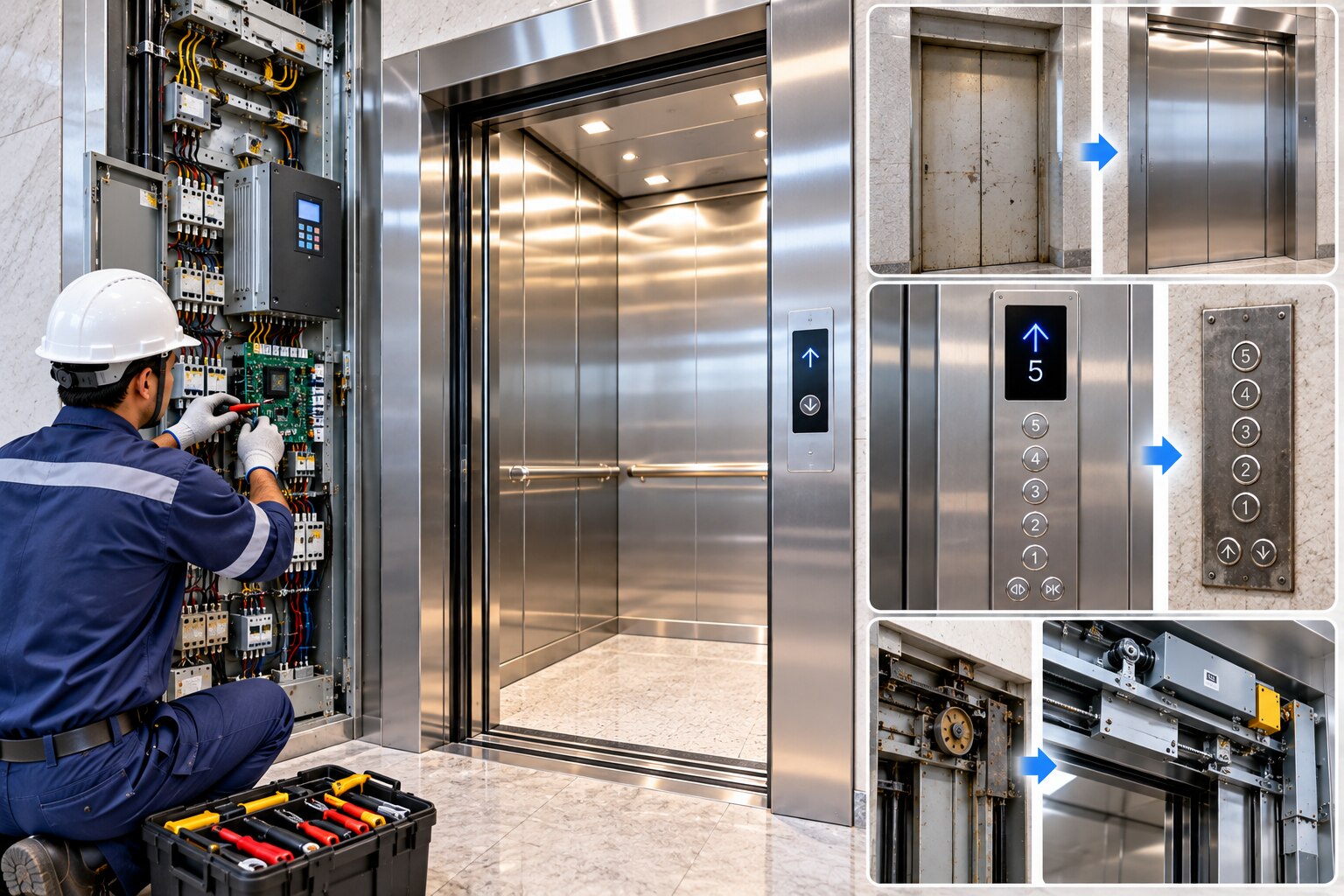
Repeated door faults, obsolete relays, nuisance shutdowns and failed safety circuits do not always require a complete lift replacement. By separating door, control and safety-system problems, you can define a modernization scope that keeps usable equipment, limits downtime and produces testable acceptance results.
Key takeaways
- Audit the car, shaft, machine, controls and safety devices before choosing upgrades.
- Replace components when ratings, clearances or safety performance fail inspection.
- Schedule commercial lift work around occupancy, traffic peaks and backup access.
- Demand test records, emergency functions and handover documents before reopening the lift.
What an Elevator Modernization Project Should Include
An elevator modernization in gurugram can retain the existing car, shaft and traction machine when their structure, clearances, ratings and safety performance suit the upgraded system.
Do not approve a controller from nameplate data alone: survey pit depth, headroom, shaft plumb, car and counterweight clearances, guide rails, machine beams, motor, brake, ropes and every safety device first.
A practical modernization scope can include:
- A new controller with a variable-voltage variable-frequency drive, updated relays, fault records and inspection controls.
- Car and landing-door operators, rollers, clutches, sills, door restrictors, locks, interlocks, door-zone sensors and reopening detectors.
- A governor, overspeed protection, safety gear, buffers and associated switches, after testing retained parts against the new speed, stopping profile and rated load.
- Emergency lights, alarm, intercom, automatic rescue or battery-lowering equipment and battery charging systems.
- Wiring, travelling cables, position sensors, levelling equipment and access-control interfaces.
A door-motor replacement alone leaves mismatched rollers, interlocks or landing entrances behind. Check lock engagement, car-to-landing coupling and reopening response. Specify protection against voltage disturbance, dust in sills and cabinets, pit water, drainage and sump-pump interlocks, plus machine-room or battery-room ventilation.
Contract tests must record acceleration, deceleration, floor-by-floor levelling error, door timing, brake stopping distance, rescue performance, emergency-light duration and full-load and empty-car travel. Tie limits to the adopted code and confirm Haryana’s inspection and operating route before handover.
How to Decide Between Repairing and Replacing Components
Approve a repair or replacement only after separating the symptom from its source. A door reopening fault can come from the door sensor, clutch, landing-door lock, door-zone signal or controller input; a lift that stops between floors can involve the brake, governor, final limit or another safety device.
1. Record the fault under controlled conditions. Note the floor, direction, load, door position, fault code, levelling error and whether inspection mode reproduces it. Do not accept a diagnosis based on a controller code alone.
2. Test the door system independently. Check operator current, rollers, clutch, sills, restrictor, car-door coupling, lock engagement, reopening detection and door-zone sensing. Repair one worn part only when the remaining operator and landing entrances pass these tests; replace the package when mixed wear causes repeated failures or incompatible signals.
3. Prove the controller’s inputs and outputs. Trace terminal identification, encoder or VVVF-drive feedback, brake command, levelling signals and door-lock circuits. An obsolete controller with unavailable relays, unstable inputs or repeated nuisance shutdowns is a replacement candidate, not a reason to bypass the safety circuit.
4. Test the wider safety chain: emergency stops, governor contacts, safety-gear contacts, final limits, buffer switches, brake monitoring and inspection controls. Assess retained governor, safety gear, buffers, rails, ropes, sheave, brake and car frame against the new speed, stopping profile, rated load and overspeed trip; include governor and safety-gear tests in acceptance.
This method prevents a partial fix from creating a hidden risk during lift modernization Gurgaon projects. Require the test records before approving the quotation.
Why Commercial Lift Upgrades Need a Different Downtime Plan
One lift out of service during a quiet office afternoon is a different risk from losing one of two lifts at 9 a.m. Passenger counts, floor-by-floor traffic and peak arrival, lunch and departure periods must set the sequence for commercial lift modernization Gurgaon work, including the agreed number of lifts kept operational.
- Schedule noisy shutdowns, material movement and testing outside peak traffic; provide a signed tenant notice and a staffed alternative route where capacity falls.
- Keep fire recall, fireman operation, emergency power behaviour, alarm signals and fire-alarm or building-management connections separately identified and tested. Automatic rescue does not replace firefighter operation.
- Coordinate access-control changes before isolating a lift. Preserve authorised floor access, visitor movement and emergency release, then restore and test card readers, destination controls and landing indicators after controller work.
- Issue a method statement covering shaft-access permits, lockout/tagout, temporary barriers, debris containment, protected finishes, delivery paths and separation of workers from occupants.
- Plan around occupied-building hazards: dust entering offices, open landing entrances, drilling noise, blocked corridors and unplanned civil work around sills or entrances.
Do not approve a controller-only programme until the contractor confirms the door entrances, landing finishes and fire interfaces require no additional shutdown. A small entrance repair can extend the outage. Set hold points for safe isolation, fire-mode verification, access-control testing and final passenger-flow observation before returning the lift to service.
The Modernization Process and Tests That Prove the Lift Is Ready
Start with a recorded baseline, not a controller quotation. A survey for elevator modernization in Gurugram should measure pit depth, headroom, shaft plumb, clearances, rail alignment, machine beams, motor and brake ratings, door dimensions, sill condition and every safety device. Confirm the Haryana approval and inspection route before ordering equipment.
1. Issue a survey report, risk assessment and method statement. For commercial lift modernization Gurgaon projects, include lockout/tagout, shaft access, temporary barriers, debris control, material movement and the agreed number of lifts that remain operational.
2. Check retained governors, safety gear, buffers, ropes, sheave, brake, rails and car frame against the new rated load, speed, stopping profile and overspeed-trip characteristics. A new controller does not make an old safety system compliant.
3. Install and commission the controller, variable-voltage variable-frequency drive, door operators, interlocks, sensors, alarms and backup lowering device. Record terminal identification; never bypass the safety chain.
4. Test every door lock, emergency stop, final limit, governor contact, safety-gear contact, buffer switch, brake monitor and inspection control individually and in the complete chain. Test obstruction reopening, nudging or reduced-speed closing, lock monitoring, closing force and kinetic energy under the applicable lift standard, including contaminated or worn sills.
5. Run no-load and rated-load cycles, measure levelling at every landing, verify smooth acceleration and braking, check emergency alarm and backup lowering, and record faults after repeated trips. Then complete the Haryana statutory inspection and any required fire-system interface checks.
Handover requires approved drawings, test sheets, certificates, updated wiring diagrams, equipment manuals, rescue instructions, defect closure records and maintenance schedules. Obtain written acceptance only after the statutory inspector’s observations are closed.
How to Compare an Elevator Upgrade Company in Gurugram
Choose a contractor by evidence that survives inspection and handover, not by the lowest installation quote or AMC rate. For an elevator upgrade company in Gurugram, require a written design covering support reactions, rope path, traction ratio, sheave diameter, brake access, heat dissipation and technician working space, especially for gearless or machine-room-less equipment.
Confirm Haryana’s approval and inspection route before signing; an OEM completion certificate or third-party load test does not replace statutory permissions or fire-safety arrangements.
| Criterion | What to compare | Reject the proposal if |
|---|---|---|
| Technical design | Door operator, clutch, rollers, interlocks, sills, controller, VVVF drive and existing landing entrances are checked together | It replaces only the door motor without proving lock engagement, coupling and reopening detection |
| Safety and environment | The specification addresses voltage disturbance, dust, pit water, drainage, sump-pump interlocks and battery or machine-room ventilation | It treats nuisance trips and corrosion as unexplained equipment faults |
| Documentation | Drawings, terminal identification, code edition, approval route, test sheets and as-built settings are included | It offers only a brochure, generic “smooth ride” statement or maintenance certificate |
| Support | Spare-parts availability, response procedure, rescue training and post-handover fault ownership are stated | The AMC excludes modernization defects or depends on undocumented bypasses |
Ask X Pro Elevators, or any bidder, to provide repeatable acceptance records for:
- Acceleration, deceleration, floor levelling error, door timing and reopening response
- Brake stopping distance, full-load and empty-car travel, emergency lighting duration, alarm, intercom and rescue-device operation
- Functional tests for door locks, emergency stops, governor, safety gear, final limits, buffers, brake monitoring and inspection controls
A lift modernization Gurgaon contract is stronger when every permitted value is tied to the adopted code edition and equipment specification.
Frequently asked questions
What should an elevator modernization project include?
Define the existing equipment to retain, then assess doors, controls, drive, wiring, car fixtures, safety devices, emergency communication and compliance testing as one system.
How do you decide between repairing and replacing elevator components?
Repair a component when it meets its ratings and safety requirements after testing. Replace it when failures involve obsolete controls, damaged safety parts, unavailable spares, poor clearances or unreliable performance.
Why does commercial lift modernization require a different downtime plan?
Commercial buildings need a phased schedule that accounts for passenger volume, accessibility, deliveries, fire procedures, tenant communication and an alternative route while the lift is unavailable.
What proves an elevator is ready after modernization?
Review functional test results for doors, levelling, overspeed protection, emergency lowering, alarms, intercoms and safety circuits, along with inspection and handover records.
How should you compare an elevator upgrade company in Gurugram?
Compare the scope of work, component specifications, testing method, downtime plan, documentation, maintenance response and experience with the building’s lift type.